The FIRST-EVER Sumplete Glossary
Why a Glossary?
Game glossaries are great for those who want to learn the lingo used by everyday players. There are a few use cases that led us to the decision to create one for Sumplete. For starters, glossaries like this one can help new players learn in-game terms for the first time, making it easier to understand discourse between more advanced players, as well as the online guides we’ve released here on the site.
Speaking of advanced players, they can benefit from our glossary as well! Some of the more niche strategies and insider tips will be covered here in addition to the basic terms and phrases.
And frankly … it helps us from an SEO perspective too (hey, long-tail queries like “Sumplete terms explained” aren’t as easy to rank for as one might think)!
Okay — for starters, let’s dive into the following alphabetized list with plain-language definitions and short examples of key Sumplete terms:
Core Gameplay Terms (A–Z)
A
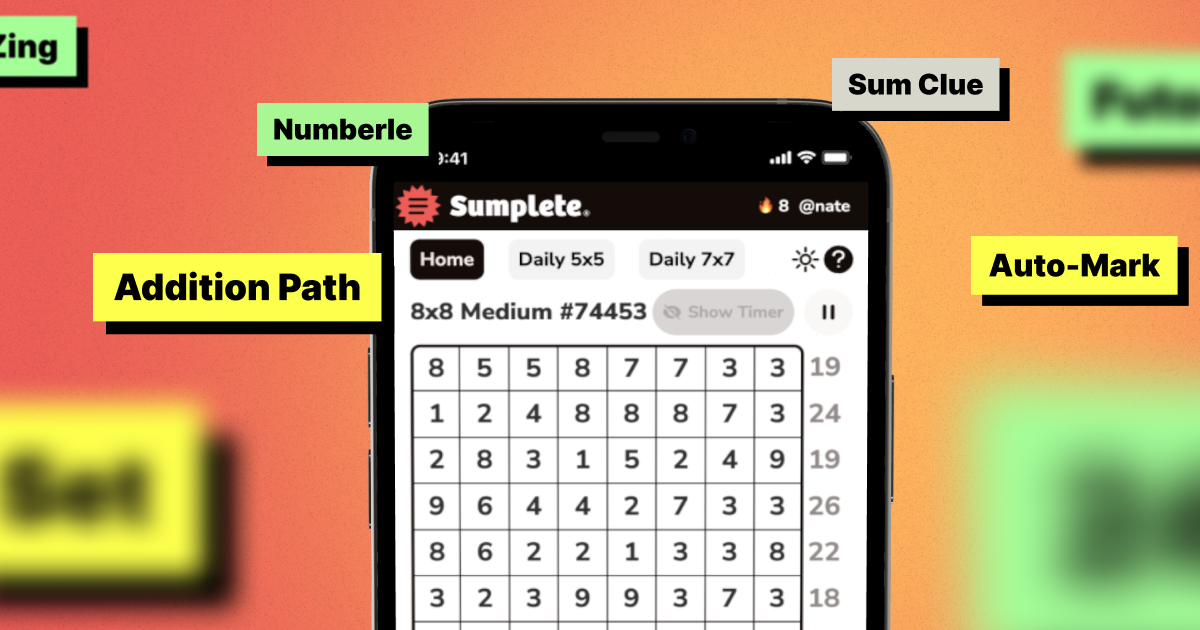
- Auto-Mark – Directly clicking a sum clue value on the perimeter of the playing board to automatically eliminate remaining unchecked cells. When executed with confidence (and correctly, of course), auto-marking can increase your solving speed as you navigate the board.
- Addition Path – A sequence of selected cells that creates a valid sum for a row or column. Example: if a row has a sum clue of 5 on a 4×4 board, and the row contains the values 2, 3, 8, and 9, the numbers 2 and 3 combined represent the addition path.
C
- Cell – The individual square in the grid containing a number that must be kept (circled) or eliminated (crossed out) by the end of the game.
- Crosshair Zeroing – The act of re-scanning intersecting lines after solving a row or column; this strategy ensures no contradictions. The “crosshair” term is derived from the imaginary intersection of the horizontal and vertical lines.
D
- Daily Board – The new 5×5 and 7×7 puzzles that are made available to players every single day.
- Deduction – The act of using logical reasoning and the process of elimination to determine which cells need to be crossed out and/or circled.
E
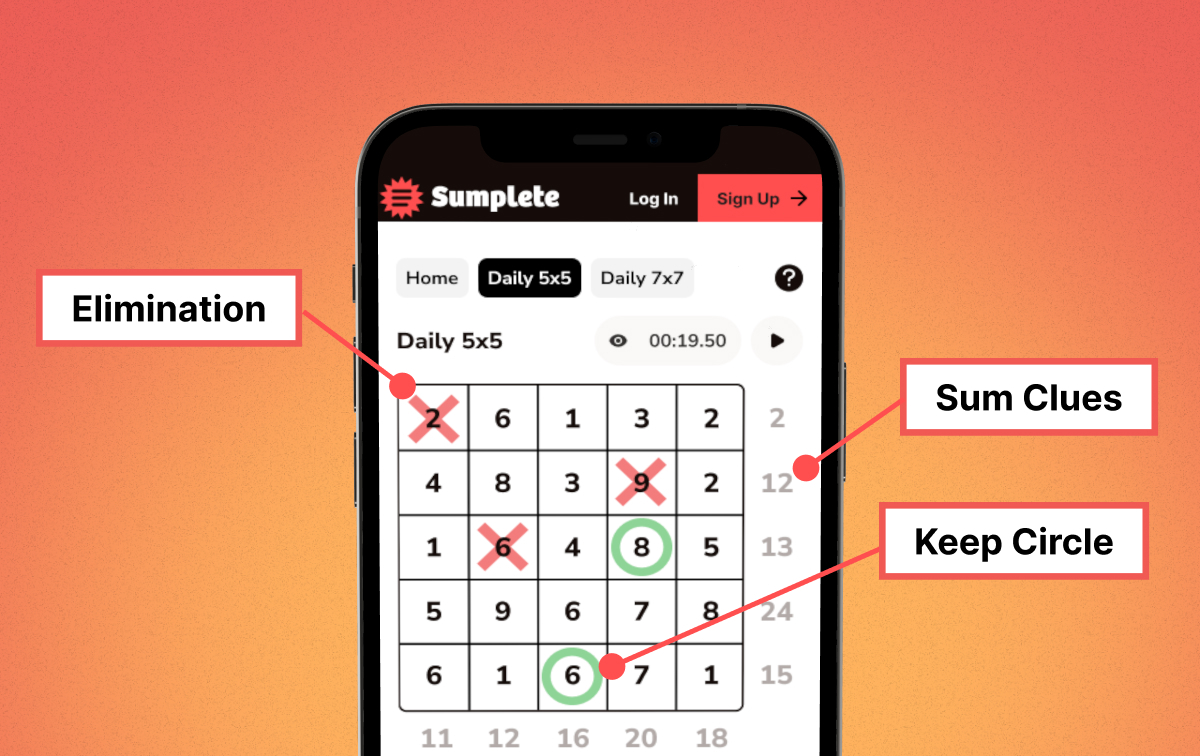
- Elimination – The act of crossing out cells with numbers that would cause a line to exceed the sum clue; when a player eliminates a value, a red “X” is displayed over that cell.
- Expert Mode – One of the upper difficulty levels (available for the 7×7–9×9 grid sizes) Sumplete players can attempt.
G
- Grid Size – The dimensions of the puzzle board (e.g., 5×5, 7×7, 9×9).
K
- Keep Circle – A visual indicator marking a number the player intends to include in a sum; a green circle will appear when a player chooses to select or “keep” a cell.
L
- Logic Path – The step-by-step deduction trail that connects decisions across multiple lines.
M
- Master Mode – The highest difficulty level (currently on 9×9 daily boards) that Sumplete has to offer.
- Mental Math – Quick addition that does not require pen-and-paper arithmetic, which Sumplete players leverage to test possible combinations.
P
- Practice Board – Non-daily puzzles ranging from 3×3 to 9×9; primarily used for skill building.
- Pair/Triple – A small combination of two or three cells (respectively) in a line that, when added together, matches the value of the sum clue target for that grouping.
R
- Residuals – The remaining unaddressed cells after partial elimination; players need to review residual cells before completing the board.
S
- Sum Clue – The target number listed at the end of each horizontal row or vertical column.
- Solve Time – The total minutes it takes a player to complete a puzzle.
- Streak – The consecutive days a player manages to finish a daily board, also known as a win streak.
T
- Target Check – The act of verifying that a line’s remaining active cells equal the target sum.
Z
- Zing – This isn’t actually an official game term, but it is a fun phrase you can say upon completing a game of Sumplete (we needed to have something start with “Z” to check off the A-Z box).
Strategy & Error Terms
Let’s get a bit more technical now — here are some more advanced strategy (and error) terms that advanced players will use when discussing gameplay:
- Over-Clearing – When a player overclears a line, they have eliminated too many cells in that particular grouping, rendering it invalid. Example: a line’s sum clue is 7 on a 5×5 board. The line contains 1, 2, 4, 8, and 9, and the player eliminates the first four values in the grouping. They have effectively made it impossible to solve for the sum clue, and in turn, have made it impossible to win until they reset their moves and try again.
- Starving Lines – Solving for one direction while neglecting the other, leading to contradictions. Lines are often starved as a result of players forgetting to leverage the crosshair zeroing strategy. While a line’s selections may achieve the sum clue in one direction, those same selections can invalidate the intersecting line.
- Undo/Redo – Reversing the last action or restoring it. Not much of a technical term, but in a game like Sumplete, where errors come with the territory, your undo/redo button will be your friend — trust us!
Difficulty Hierarchy
There are five levels of difficulty that Sumplete players can play. They’ve been listed below from the easiest level to the most challenging:
- Easy
- Medium
- Hard
- Expert
- Master
Here’s the thing: not every difficulty level can be accessed across every grid size. Players can play the easy level at any grid size, while the medium level is limited to the 6×6 to 9×9 boards. Hard and Expert only apply to the 7×7 to 9×9 grids. Oh, and Master-level? That’s reserved for the 9×9 board only.
Aside from the grid size, the escalation of difficulty results in an increased distribution of higher sum clues and a reduced frequency of lower targets. This enhances the cognitive load required for players to solve the board, as higher sums are more difficult to solve as the game progresses, in large part due to the increased number of potential addition paths and invalid intersecting combinations.
Related Puzzles (Cross-References)
Sumplete incorporates elements found in several other popular number logic games, including:
- Sudoku: A logic-based grid game requiring players to fill in numbers 1–9 without repeats in each vertical column, horizontal row, and each of the nine 3×3 squares on the board. Sumplete also has logical requirements for intersecting lines, but it leans into addition more than logic and repetition avoidance.
- Kakuro: This game features arithmetic cage sums, challenging players to fill empty spaces on the grid with numbers that add up to the vertical and horizontal target values (without repeats, of course). Sumplete features similar addition-based gameplay, but offers fuller, more traditional playing boards.
- KenKen: Those seeking a game that blends arithmetic and logic will enjoy trying KenKen. KenKen grids have partitioned cages, each with its own target number and required mathematical operation. Players must fill cages using the required mathematical operation to achieve target numbers without repeating digits across any of the rows or columns on the grid. Sumplete doesn’t include multiplication or division, but it does mandate players to use addition and subtraction to reach sum clues (target values), similar to KenKen.
- Numberle (or Mathler): This is an equation-guessing game inspired by the likes of Wordle. This math puzzle requires players to guess the values in an 8-part mathematical equation using digits and operators. In the end, the mathematical equation must be correct for the player to win. In Sumplete, the addition equations within each row and column must yield correct answers to match the sum clues and solve the board. While you are welcome to guess inputs in either game, you might have more success in the later rounds of a Numberle game than you would in Sumplete.
Visual Examples
Perhaps you learn to play best with visuals, and need to see these terms outlined to really improve your grasp of Sumplete lingo. No problem — check out our annotated 5×5 board below:
Also, since we get asked about this a lot, we wanted to capture what an auto-mark looks like in action through this quick demo video below:
What Now?
If you’ve read this far, we have a unique request for you: bookmark this page so you can return to it when you might need a quick reference in the future!
There are a lot of terms and phrases that we throw around when playing Sumplete, and it can get confusing if you’re not in the know. There’s also a good chance new terms and strategies will make their way into this glossary as more players join our leaderboards.
Who knows? You might say a word mid-game or drop a new strategy in our Discord that will be coined as the newest Sumplete term.
Maybe it will even find a home in this glossary!
Ready to apply these terms? Play today’s Daily 5×5 or 7×7 Master!
Other Helpful Sumplete resources
 Mini Crossword
 Midi Crossword
 Diffle
 Killer Sudoku
 Numberle