Sumplete vs Number Sums: What’s the Difference?
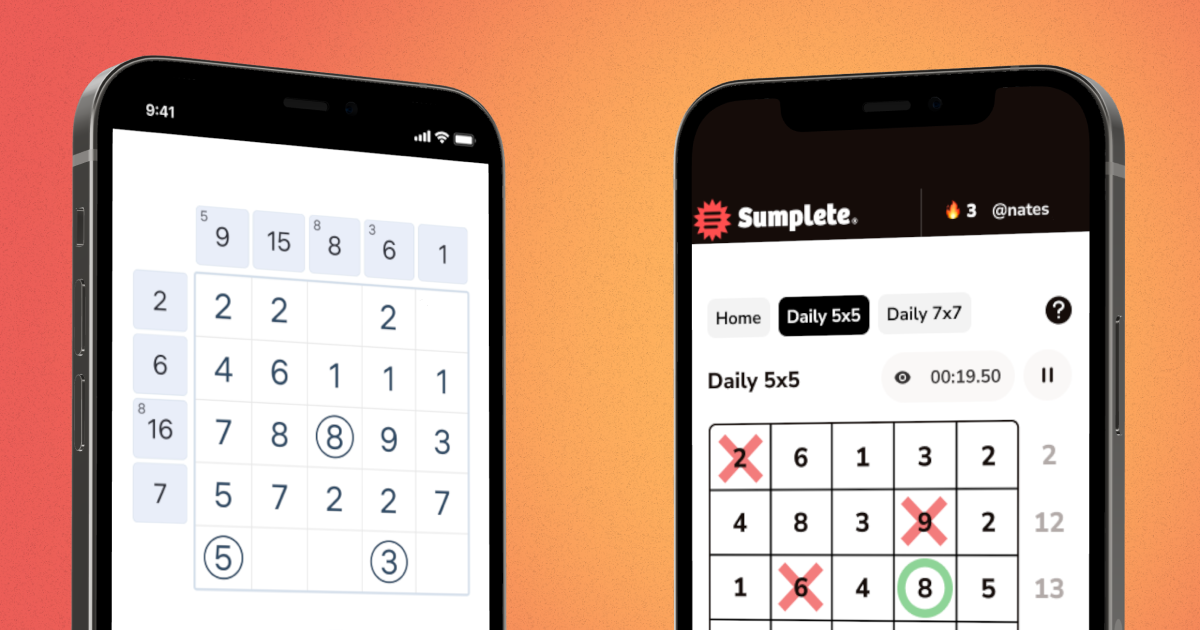
How does Sumplete compare to traditional Number Sum puzzles?
To understand how we arrived at a game like Sumplete, we need to quickly review the history of its predecessor — Number Sum puzzles. Sumplete is an advanced (and fun) iteration of traditional Number Sums, but we didn’t just transition from one to the other.
Quick Comparison Table
Gameplay Comparison: Number Sums vs Sumplete
| Feature | Number Sums | Sumplete |
|---|---|---|
| Core Mechanic | Arithmetic completion | Elimination-based logic |
| Math Skills Used | Addition and subtraction | Addition and deductive reasoning |
| Format | Worksheet or static puzzle via digital application | Interactive digital grid |
| Difficulty Range | Easy → Medium | Easy → Master |
| Solve Time | 1–3 min | 3–8 min |
| Replay Value | Low | High with daily challenges and practice modes |
| Best For | Students building math fluency | Players who enjoy logic and speed |
What Are Number Sums?
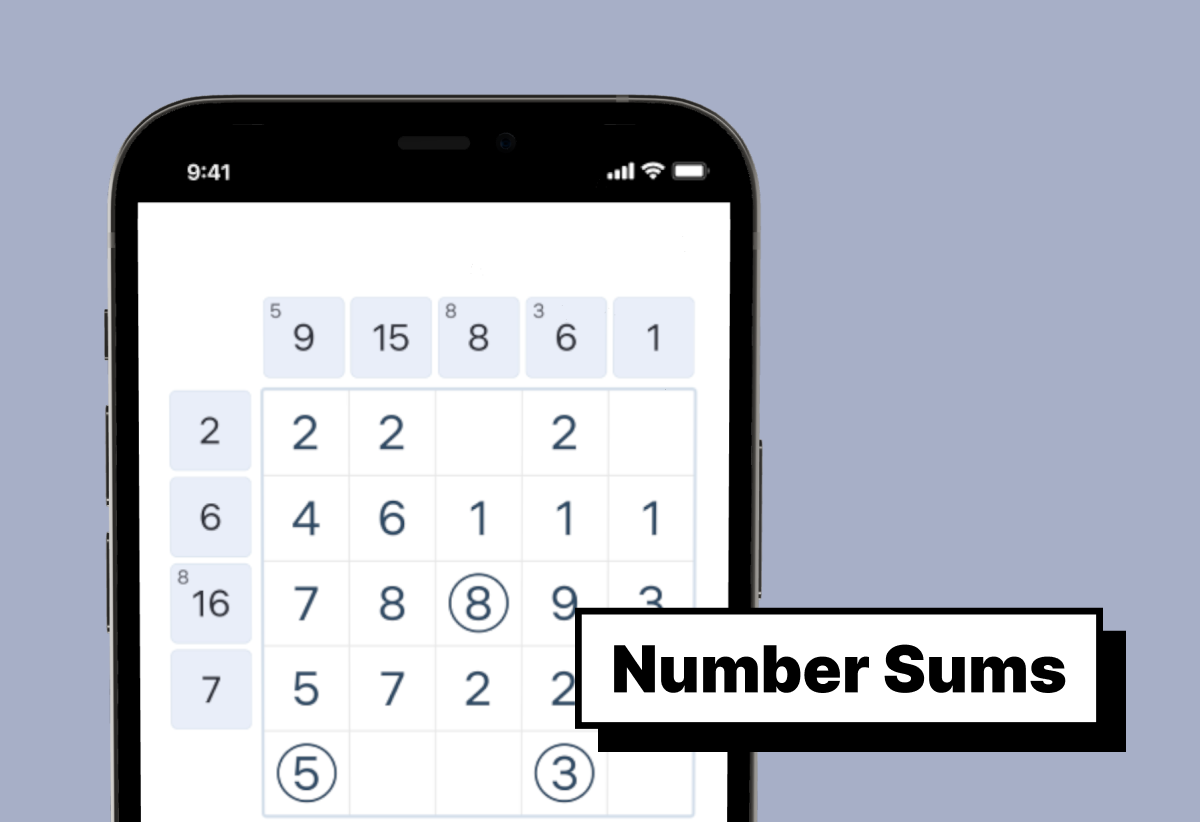
Traditional number sums are simple mathematical equations that require basic arithmetic to solve. They are also known as fill-in-the-blank math exercises, with one of the elements missing from the final equation. Here’s an example of a traditional Number Sum puzzle:
4 + __ = 9
In this case, the missing value is 5.
Typically, these number sum puzzles are compiled on a worksheet or a timed mental math application. Often, in educational environments, students are tasked with solving as many of these puzzles as they can in a given time frame, such as five- or ten-minute periods. The goal is to improve the player’s arithmetic fluency while simultaneously quickening their ability to complete basic equations.
Unfortunately, these puzzles come with a few critical limitations. For starters, they are limited to one-directional solving, meaning that once the equation is completed, there aren’t any additional elements to the puzzle. It’s a straightforward challenge that, while useful, lacks the logical depth that many modern puzzle enthusiasts seek.
Ever since Sudoku hit the scene in the U.S. in the late 1970s, number logic puzzles have rapidly evolved from classic arithmetic drills into interactive games. Communities for games like Sudoku, KenKen, and now Sumplete have exploded in recent years. Millions of people are competing daily to solve puzzles faster than their friends and fellow players.
What Is Sumplete?
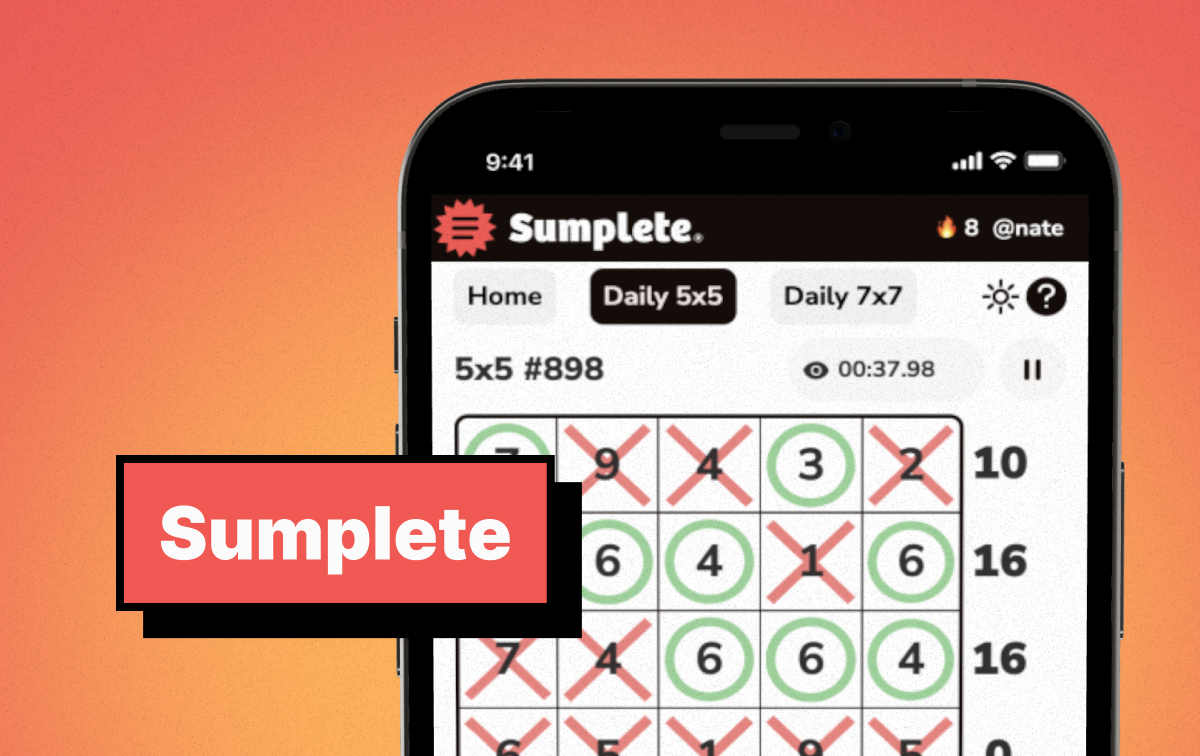
Sumplete is a number-logic puzzle combining math and deduction. Players must select or eliminate cells within the vertical and horizontal lines that make up the grid. The sum of the selected cells in said lines must match the value of the sum clue associated with that row or column. Sum clues are positioned along the perimeter of the playing board.
Pattern recognition, mental addition and subtraction, and logical sequencing are critical skills that players must leverage if they wish to solve Sumplete boards quickly.
There are multiple grid sizes that players may select, such as the 3×3–9×9 practice boards, which offer unlimited playing sessions, as well as the daily 5×5 and 7×7 challenges, which are refreshed every day. Learn how to play Sumplete now!
Which Builds Better Math & Logic Skills?
Both Number Sums and Sumplete can help students and players build math and logic skills, but Sumplete is the better training tool.
There is definitely an educational crossover between the two games. Number Sums sets the foundation for students and younger players as they develop the rudimentary arithmetic speed and accuracy needed for more advanced tests like Sumplete. Sumplete, in addition to improving mathematical ability, also enhances players’ reasoning, focus, and cross-referencing logic.
Teachers may also opt to use Sumplete to build basic arithmetic fluency in a game context. The game’s easier modes and smaller grids can be great resources for educators who are looking to introduce a new learning pathway to their classrooms.
What Are Some Common Player Mistakes in Each Game?
There are common mistakes in both puzzle games that cause players to waste time and input incorrect values.
In Number Sums, players who misread equations or rush answers will often find themselves inputting the wrong values, which results in fewer correct answers during the timed period.
Sumplete players will often over-clear lines, meaning they eliminate too many values in a given row or column, making it impossible to achieve the sum clue for that line. Many players also make the mistake of ignoring intersecting lines. This means they will select values whose sum is equal to the sum clue in one direction, but are invalid inputs for one of the lines in the opposite direction.
While this next error can be considered rather minor in comparison to the other two, it is a mistake that can cost players precious time as they navigate the board — skipping the lowest sum clues first. Addressing lines with low sum clues first is the best way to make quick progress on a fresh Sumplete board. Ignoring this step can overcomplicate the game and potentially result in errors that could have been easily avoided.
Check out our recent blog, “7 Mistakes Beginners Make in Sumplete,” for a full list of common Sumplete pitfalls — and how to avoid them.
What Are Some Strategy Tips for Each Game?
For Number Sums
- Always start with the shorter, less complicated equations to rack up easy wins first. By addressing these equations at the beginning of your attempt, you can ensure a few near-guaranteed correct answers.
- Use inverse operations to check your work and validate your answer.
Here’s an example:
5 + __ = 19 ❓
5 + 14 = 19 💡
19 - 14 = 5 ✅
For Sumplete
- Always start by targeting “0” sum clues (if applicable). Then solve for the next lowest sum clues. These lines will have fewer valid cell combinations, making them easier to solve quickly.
- Don’t forget to use crosshair-zeroing to verify intersections. Make sure that a line solved in one direction doesn’t invalidate any of the intersecting lines in the opposite direction. Related: Sumplete Glossary of Terms
- Only auto-mark lines after confirming residual cells. This can help you save time! Just make sure you have addressed your residuals and confirmed your selections for each line before automatically eliminating the rest of the unmarked values in that row or column.
Verdict: Which Game Should You Play?
If you seek a straightforward arithmetic puzzle game, choose Number Sums. But if you want to test your logical reasoning and problem-solving abilities in a fast-paced environment, you should play Sumplete.
Remember, these games complement one another, so playing both titles can be an integral component of a balanced cognitive training regimen.
Sumplete vs Number Sums: FAQ
Is Sumplete harder than Number Sums?
Sumplete is a harder game than Number Sums as it requires more than just arithmetic skills to complete. Logical reasoning, pattern recognition, quick mental math, and strategic sequencing are all elements of a standard Sumplete game. If you're looking for more like it, read our list of games like Sumplete.
Can kids play both?
Of course! We encourage young students to try both puzzle games to improve their math skills and reasoning ability.
Which improves math speed more?
Both titles can effectively improve a player’s math speed.
Are Number Sums still useful for adults?
Yes! Solving Number Sums is a great way for adults to keep their arithmetic skills sharp.
Should I Try Both Games?
Absolutely! You should try both games by clicking the links below!
- Play today’s Daily 5×5
- Practice Number Sums-style logic on Unlimited Boards
 Mini Crossword
 Midi Crossword
 Diffle
 Killer Sudoku
 Numberle