What Is a Nonogram? Rules, Strategy & How It Compares to Sumplete
Quick Comparison Table
For those who need a fast display of info, here's what you need:
Game | Core mechanic | Puzzle type | Difficulty | Best for |
Nonograms | Fill/mark squares based on row & column clues | Picture-logic | ⭐⭐⭐ | Casual puzzle & visual players |
Sumplete | Delete numbers so remaining ones match target sums | Number-logic | ⭐⭐⭐ | Math lovers & grid puzzle fans |
Sudoku | Place digits 1–9 so each row, column, and 3×3 box contains all without repeats | Number-placement | ⭐⭐⭐⭐⭐ | Logic purists & puzzle traditionalists |
On This Page
- How Nonograms Work
- Rules & Mechanics
- Step-by-Step Example
- Strategies & Techniques
- Common Mistakes
- Nonogram vs Sumplete
- Who Nonograms Are For
- Recommended Games
- FAQ
How Do Nonograms Work?
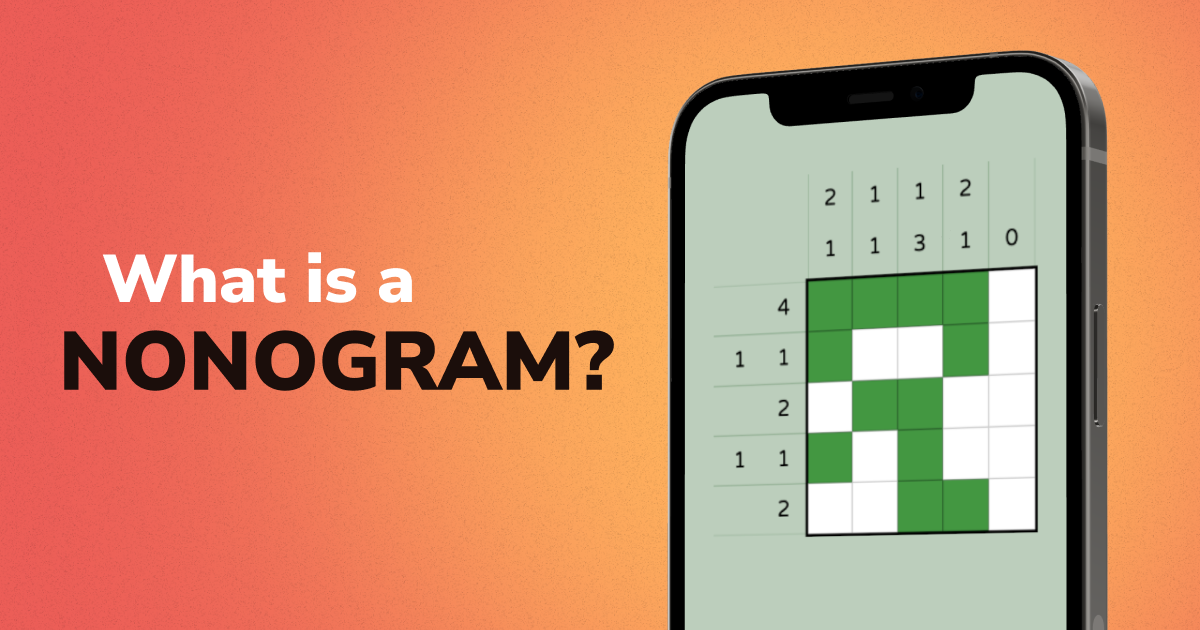
Nonogram boards feature square grids of varying sizes (5x5, 10x10, 15x15, etc). There are two sets of numeric clues on each Nonogram grid. The numbers along the top of the board indicate the number of consecutive shaded squares required for each of the columns below; these are also known as column clues. The numbers that run vertically along the left side of the board are known as row clues, and they represent the number of consecutively shaded squares required for each of the rows to the right.
Let’s review a few examples of this consecutive block logic using a hypothetical 5x5 board.
A column clue of “3” means three cells must include shaded squares somewhere in the line. In this case, there are only three options: squares can be added to the top three cells, the middle three cells, or the bottom three cells in that column.
A row clue of “1” means one cell must be shaded in with squares somewhere in the row. Because there are five cells in the row, the square can be added anywhere within the line, as long as it doesn’t invalidate the intersecting line (we’ll come back to this in the next section).
Some clues will include multiple numbers. Let’s say a board has a column clue with the number “3” on top of the number “1.” This means that three shaded squares must appear in that column, followed by a space (represented by an X), followed by a single shaded square (in any direction). On a 5x5 board, this means the top three cells are shaded, followed by a space and a single shaded square. It’s important to note that spaces or Xs aren’t limited to a single cell — they can span multiple cells within a given line.
At the end of a Nonogram game, an image of a symbol, character, animal, or other item will emerge, signaling a victory.
What Are Some Basic Nonogram Tips?
- Shaded & Empty Squares: Only add shaded squares when you are confident in their placement. Leave cells empty if you are uncertain about their status on the board.
- Marking Xs: Similar guidance can apply to marking Xs — if you are unsure if a cell is to be eliminated from the shaded square contention, leave it empty! If you know it needs to serve as a dedicated “space” cell or is definitely ineligible to serve as a shaded cell, then and only then should you mark your “X.”
- No Early Guesses: Early guesses can kill your Nonogram board. Just because something looks or feels right early, doesn’t mean it will be right in the end. Take time to evaluate the board and make informed decisions throughout the game.
- Clues Require Exact Matches: If a clue lists 2 over 1 for a column or 1 before 3 for a row, the order of the shaded squares and spaces must match that sequence exactly.
- Contradiction Avoidance: Much like other number logic games, a Nonogram line that is valid in one direction can often contradict the logic in the other. Make sure your cell decisions don’t invalidate intersecting lines!
Step-by-Step Solving Example
Step 1: Start with Full Rows/Columns
Start by checking for any rows or columns with clues that provide guaranteed answers to their corresponding lines. On a 5x5 board, a row clue of “1 1 1” means that the first, third, and fifth cells have to be shaded in, while the second and fourth cells in the row have to be Xs.
Step 2: Use Overlaps
Overlapping clues can be very helpful when solving Nonograms. If the middle column of a 5x5 board simply reads “1” while the middle row reads “1 1 1,” you can confidently assert that the cell at the center of the board will be shaded in, meeting the criteria for the vertical column.
Step 3: Cross-Marking Empty Cells
Let’s continue with the example above — once the first, third, and fifth cells have been shaded in, immediately cross-mark the empty second and fourth cells of that row. You know they can’t possibly house shaded squares, so it’s best to definitively eliminate them from the board to prevent adding shaded squares to them when assessing intersecting lines.
Step 4: Alternating Between Rows + Columns
Speaking of intersecting lines, it’s always beneficial to alternate directions when solving Nonograms to avoid logical contradictions. In the previous example, we solved for the middle vertical column using the overlapping strategy, and then solved for and cross-marked the middle row. This alternation is a great way to prevent erroneous cell selections.
Step 5: Final Contradiction Check
As we mentioned previously, empty cells should be left empty until we can confidently eliminate them. After alternating and checking each row and column for contradictions, we can then proceed to cross-mark all remaining empty cells to solve for the final image.
Core Nonogram Strategies
Line Scanning
Line scanning involves players alternating between columns and rows to find clues that, when combined, offer hints as to which cells need to be shaded in and which are to be left empty. Line scanning can help players solve for entire rows or columns, but it can also be leveraged to determine the placement of squares or Xs in singular cells as well.
Solving for Single-Option Blocks
Some blocks (sets of consecutive shaded squares) can be easily solved because they have line clues with only one possible answer sequence. These are known as single-option blocks. Some single-option blocks may only require a player to assess a clue in one direction — this information alone might be enough to solve the line.
Overlapping Technique
Players who use the overlapping technique look for clues across intersecting columns and rows that yield a single answer sequence. Some single-option blocks reveal themselves after the logic of intersecting lines is applied (see above for an example of this technique in action).
Considering Max/Min Ranges
Skilled players will always try to take the maximum and minimum cell ranges into account for each line. A row with a line clue of “1 2” on a 5x5 board can take up 4-5 cells. Here’s how: the block only takes up four cells if there is one space between each of the sets of shaded squares. However, it can also take up five cells if there are two spaces between the sets. This strategy becomes considerably more valuable on the larger grid sizes as ranges increase due to the higher number of possible “empty” cells between shaded squares.
Edge Anchoring
Some players will use edge anchoring to eliminate cells from the playing board. Players will fill in a corner cell on the board and immediately check for contradictions. If a contradiction is found, they eliminate the cell and move on to the next corner. If a contradiction is not found, they leave it blank before progressing.
Backtracking (When Used Carefully)
We almost didn’t include this strategy out of concerns that it would lead to more dead boards than solves. Advanced players will sometimes make a series of guesses in the later stages of the game before backtracking upon hitting a contradiction. If used correctly, this strategy could lead players to a successful solve. If used erratically, it could result in a big waste of time.
X-Mark Management
X-Mark Management refers to a strategy in which players will confidently eliminate cells with X-marks while leaving those still under consideration empty until they can be definitively addressed. Players who are diligent when it comes to X-Mark management often find success faster than those who either cross out every cell they believe is a space or ignore crossing out cells until the end of the game.
What Are Some Common Nonogram Mistakes New Players Make?
Now that we’ve walked through a step-by-step Nonogram solve guide and covered some of the best strategies used by players today, we figured it would be useful to cover some of the most common pitfalls and mistakes committed by Nonogram players as well:
- Guessing Too Early: Early guesses can result in mistakes, which can lead to contradictions and dead boards. Guessing later in the game can be used as a part of the backtracking strategy, but the justification for this approach to be deployed within the first couple of moves simply isn’t there.
- Miscounting Block Lengths: Miscounted blocks can invalidate the line you are solving, not to mention the intersecting lines. Forgetting to shade in that last cell in a sequence (or adding an extra square) can have some really devastating consequences on your game progression.
- Forgetting Required Spaces: Ironically, forgetting required spaces is very similar to miscounting block lengths — it can result in mistakes in multiple directions. Missing an empty space can be equally detrimental as making a mistake with a shaded square.
- Ignoring Cross-Marks: Placing a shaded square in a cell that was previously marked with an X can invalidate a previously solved line. If anything, players should backtrack their entire board to undo their cross-marking, not ignore their previous placements.
- Losing the Row/Column Sync: Failing to alternate between rows and columns can lead to moves validating some lines while simultaneously invalidating others in the opposite direction. Avoid solving for a single direction when possible.
- Overfilling because the Picture “Looks” Wrong: Making adjustments in an attempt to guess the final picture is trickier than it looks, and can often result in several mistakes.
Nonogram vs Sumplete (Comparison)
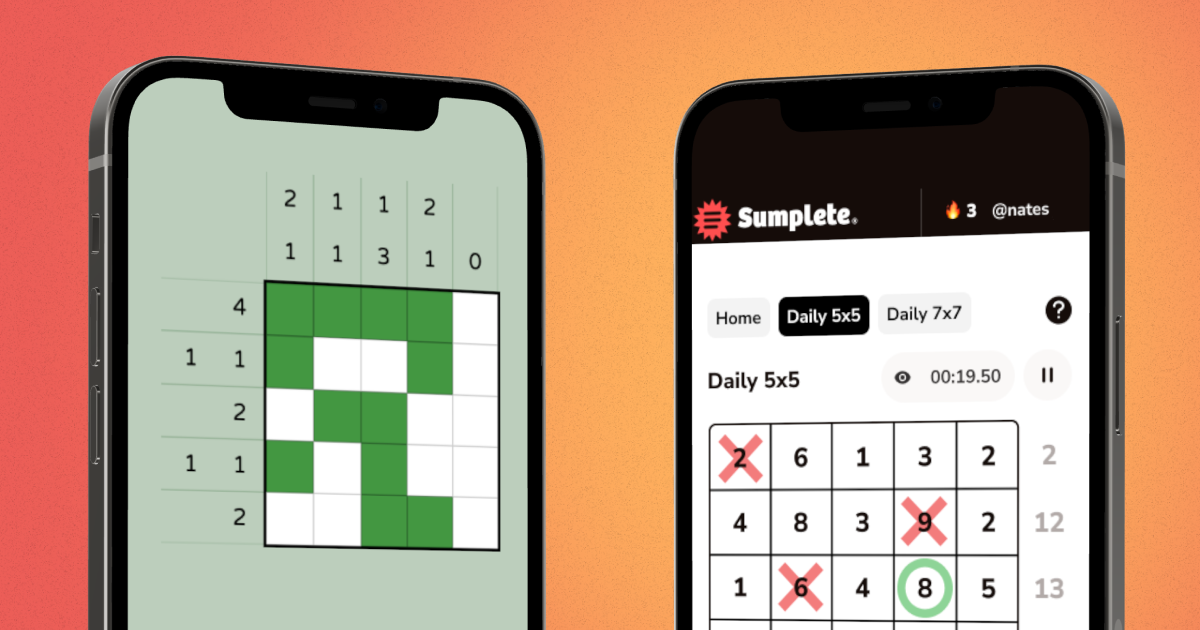
Nonograms have a few similarities to our number-logic puzzle game, Sumplete. For a more in-depth comparison, read our Nonogram vs Sumplete article.
Logic Type
Logic is a key element in both games. Nonogram players must leverage spatial deduction to win, while Sumplete players need to combine arithmetic elimination and intersection logic to solve boards.
Skill Overlap
Both Nonograms and Sumplete require similar skills to complete. Players with strong line scanning ability, contradiction detection, and intersecting-line reasoning will achieve success in both games.
Difficulty Curve
Both games offer varying square grid sizes. Sumplete offers boards between 3x3 and 9x9, whereas Nonogram boards can be much bigger, with some boards reaching 25x25 and higher.
Solve-Time Comparison (High-Level)
A Sumplete game runs anywhere between 3-8 minutes on average. Nonogram puzzles vary based on the grid: a 5x5 board typically takes 2-5 minutes to solve, whereas the 10x10 board usually runs between 10-15 minutes. The 15x15 board is considerably more difficult, with most players taking 30-45 minutes to solve the board.
Who Would Enjoy Nonograms?
There are a few common traits across players who enjoy Nonograms and similar titles. Players who find Nonograms enjoyable are usually visual thinkers who would rather solve puzzles with slow methodology and logic than to guess answers in rapid succession. They probably find similar titles such as Sudoku, Picross, Hitori, and Kakuro to be fun challenges, if not staples in their daily rotation.
Recommended Nonogram Games to Try
There are many ways to play the best free Nonogram games, as well as Nonogram variants that are just as fun and challenging.
Nonograms.co is the pick if you don't want to install anything. It runs in the browser with no signup, and you can play nonograms online at whatever size matches your patience that day — from a 5x5 warm-up to a 25x25 grid that will eat your lunch break and ask for seconds. There's also a puzzle creator if you'd rather design a grid than solve one, and a nonogram basics guide if the rules above still feel slippery.
Nonogram.com is Easybrain's mobile app and a solid starting point for beginners. The rules are clearly laid out and there are multiple board sizes to select. It's a no-frills experience — with the tradeoff that it's an app store download rather than something you can open in a tab.
Griddlers.net features a "Griddler of the day" similar to the Sumplete Daily boards. Unlike our 5x5 and 7x7 daily offerings, the daily Griddler game is a 20x20 grid. The site also hosts daily games across multiple Nonogram variants.
Pixelogic offers a unique selection of Nonogram variants — and by unique, we mean all 24,976,511 solvable 5x5 nonogram puzzles.
There are also many free web Nonogram generators available online if you are looking for different variations or new daily game offerings.
FAQ
What is the goal of a Nonogram?
The goal of a Nonogram game is to add shaded squares and empty, cross-marked cells in vertical columns and horizontal rows on a square board. Each of the cell selections in a given line must match the sequences represented by the clue associated with said line. The player wins once the correct sequences have been added across all of the rows and columns on the board without any contradictions.
Are Nonograms the same as Picross?
Yes, Nonograms and Picross are fundamentally the same exact game. Picross is a brand name owned by Nintendo; it is featured across multiple games in its portfolio.
Are Nonograms hard to learn?
Nonograms are easier to learn at the lower levels, but they get progressively harder to solve as the board sizes expand and the complexity of the line clues increases. They're actually an ideal game for adults in particular, along with other logic puzzles for adults.
Do Nonograms require math?
Nonograms don’t require math in the traditional sense. While the game doesn’t require any arithmetic in the form of addition, subtraction, division, or multiplication, it does force players to keep track of combinations, number ranges, and number sequences.
What size Nonogram should beginners start with?
Nonogram beginners should start with the smaller 5x5 board before progressing to the larger grid sizes with more complex line clues.
 Mini Crossword
 Midi Crossword
 Diffle
 Killer Sudoku
 Numberle