Nonogram vs Sumplete: A Clear, High-Signal Comparison
What is a Nonogram?
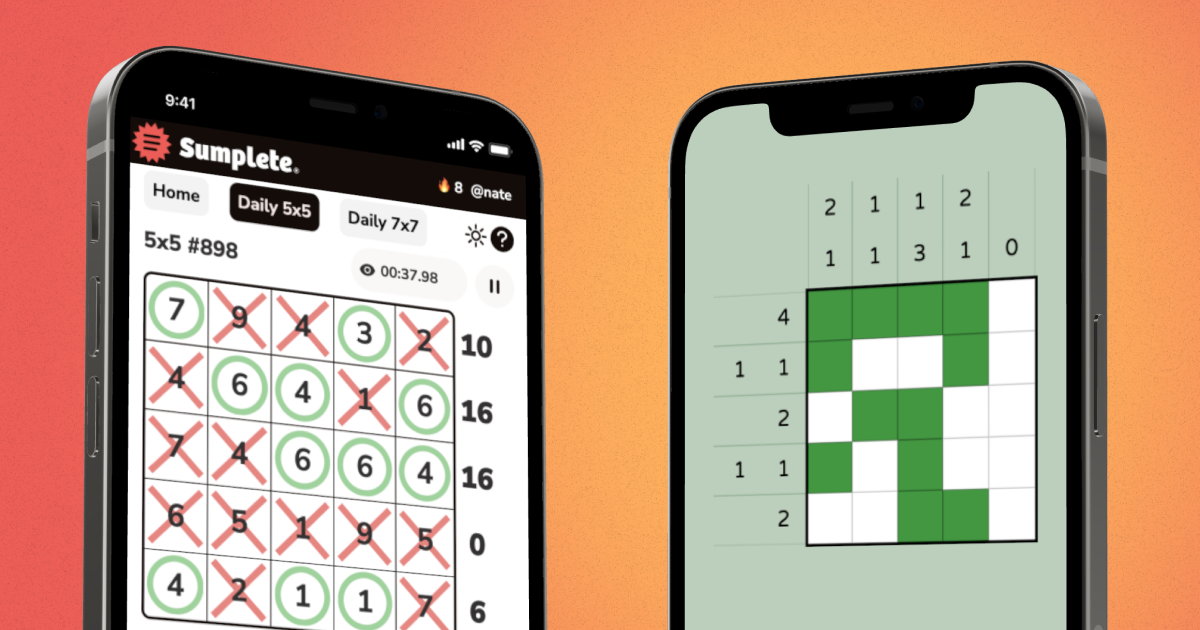
A Nonogram is a picture-logic puzzle where players shade in squares and mark Xs on a grid using row and column clues to guide their selections.
Each line clue number corresponds to the length of the consecutively shaded blocks. A “1” line clue represents a single shaded square, while a line clue of “2” represents two consecutive squares, and so on and so forth. In some cases, multiple numbers will appear within line clue sections. This calls for the player to shade in the squares that match the value of the first clue, followed by a space (or multiple spaces), which are then followed by squares that match the value of the next clue. When solved, the final pattern on the grid forms a small image.
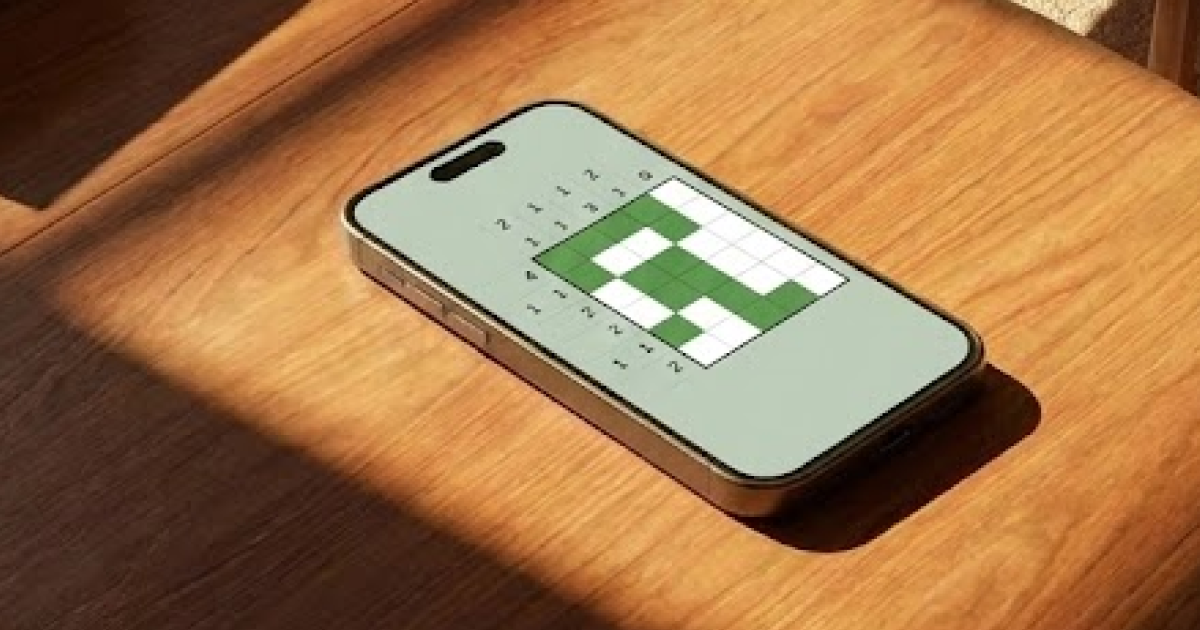
Nonogram’s core mechanics include:
- Line-based deduction using numeric block clues
- Shading in squares, crossing out remaining cells
- Contradiction-based elimination
- Assessing intersecting lines to refine possibilities
The primary skill Nonogram players need to succeed is spatial and pattern-based logic.
What is Sumplete?
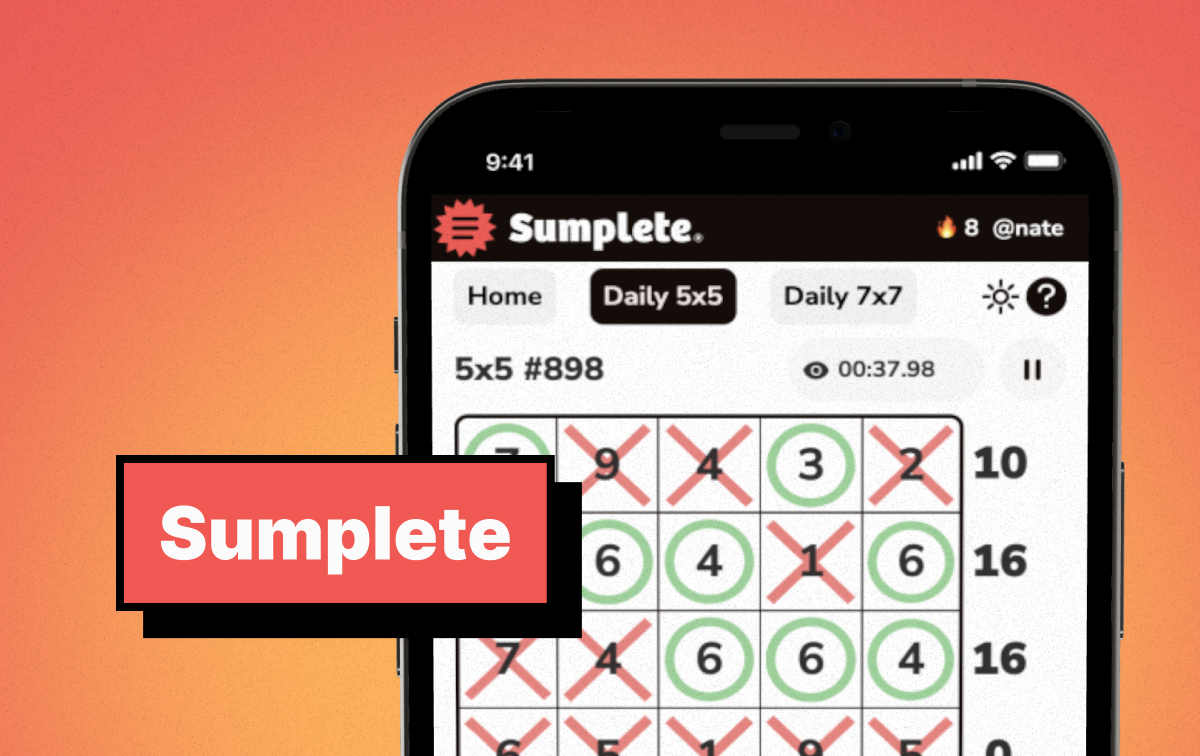
Sumplete is an arithmetic elimination puzzle in which players must select and eliminate numbers across a square grid. The sum of numbers in each row and column must match the designated sum clue associated with each line. The remaining numbers are eliminated. Once all the sum clues have been solved, the player wins.
Sumplete’s core mechanics include:
- Addition-based deduction
- Selecting values via Keep circles and eliminating others via Xs
- Crosshair logic (scanning intersections on the grid to solve lines)
- Executing auto-mark actions on solved lines to quicken solve times
The primary skills Sumplete players need to succeed are numerical reasoning and intersecting-line logic.
What are the Key Differences?
Feature | Nonogram | Sumplete |
|---|---|---|
Primary logic type | Spatial deduction from block clues | Arithmetic elimination with target sums |
Goal | Reveal a pixel-style image | Match every row and column to its sum clue |
Solving style | Block and space placement using overlaps | Build valid addition paths, prune with intersections |
Skill emphasis | Visual logic and pattern recognition | Mental math, deduction, and cross-line reasoning |
Difficulty curve | Larger grids become exponentially harder | Higher sums and more intersections increase complexity |
Guessing | Penalized; sometimes required in late-game states | Rarely required unless chasing record times |
Typical solve time | 10–30 minutes for mid-sized grids | 3–8 minutes for 5×5–7×7 boards |
Overall feel | Slow, methodical, and meditative | Fast, tactical, and time-pressured |
Looking for more free daily number games? See the full list of number games for adults →
What are Some Similarities Between Nonogram and Sumplete?
Nonogram and Sumplete are two different games on the surface, but they share a common DNA. Despite promoting two different systems of play, both puzzles share a similar foundation rooted in logic:
Scanning Intersecting Lines
In both Nonograms and Sumplete, progress in one direction can be deceiving, as a successful solve in one direction can constrain the other. This is why crosshair scanning is so critical in each game. Crosshair scanning in Nonograms can prevent erroneously placed squares or spaces, and the same strategy can ensure players aren’t selecting values in one line that will invalidate a line in the opposite direction.
Pure Guessing is Discouraged
Randomly guessing answers can hurt you in either game. Both Nonogram and Sumplete reward clean deductive reasoning over random stabs. Randomly guessing square or empty cell placements in the former is common, as many players will try to guess the final image instead of playing the game the way it is designed. Unfortunately for them, the success rate of this strategy is minimal at best. The same can be said for Sumplete — random guesses often result in a spike in invalidated lines, which only wastes precious time in the end.
Line-by-Line Solving
Players naturally alternate between rows and columns when solving Nonograms and Sumplete boards through a process known as crosshair scanning. In Nonograms, this strategy helps players catch line clues with single-option block placements. Sometimes, players might clear an entire line sequence by glancing at intersecting clues. In Sumplete, crosshair scanning helps players avoid invalidating opposing lines.
Strong Daily Rhythm
Both games are ideal for a daily challenge loop. Nonograms offer special daily, weekly, and monthly games, while Sumplete offers daily 5x5 and 7x7 challenges.
Which Puzzle Is Harder?
It’s hard to say whether one game is harder than the other. The individual abilities possessed by one player may make one game easier for them than the other, and vice versa.
Nonograms tend to feel harder because spatial deduction compounds quickly. At a certain point, players may have to guess or rely on trial-and-error methods to advance. One wrong block can cascade into a broken picture, and backtracking can be difficult if the player can’t recall their initial progression.
Sumplete’s difficulty spikes with higher sum ranges and denser boards. That said, it remains more deterministic and less guess-heavy.
Who Should Play Nonograms?
Players who enjoy pixel art logic will be big fans of Nonograms, even more so if they prefer slow, methodical deduction over fast-paced arithmetic. Nonograms are also great for visual pattern enthusiasts who will find great joy in solving for the reward image that appears at the end of each game.
Who Should Play Sumplete?
Players who find fast, 3-8 minute, arithmetic-based puzzles fun should give Sumplete a try. These puzzle loops require players to juggle between multiple possibilities in a race against the clock. There’s no image construction involved here — just clean number-based deduction.
Unsure which level you should play?
Try the Daily 5×5 if you want a warmup. Try the Daily 7×7 if you want a fight!
What are the Best Opening Moves for Each Puzzle?
Nonogram Opening Moves
- Start by looking for full lines, which are rows or columns with clues that are equal to the length of the line. These lines are the easiest to solve at the beginning of a Nonogram game.
- Use the overlapping technique on partial lines to determine if any cells or lines have single-option answers.
- Mark impossible cells, or cells that cannot contain squares due to the intersecting clues, with Xs.
Sumplete Opening Moves
- Scan for low-sum lines, as these are the easiest lines to solve for at the beginning of a game of Sumplete.
- Identify pairs or triples — sets of two or three values in a line that match the sum clue without invalidating any intersecting lines.
- Use crosshair targeting to make correct selections and eliminate obvious contradictions. This, in turn, prevents invalidated lines.
Something you may have already noticed about both of these strategies — they both begin with structure and end with refinement.
Nonogram vs Sumplete: Which One Is Better for Brain Training?
Both games are great for brain training. They just train different muscles.
Nonograms help players improve their spatial working memory as they identify which cells should contain squares and which should be left as empty spaces. This simultaneously improves their pattern recognition and completion skills. Nonograms also help players with their attention to detail — scanning for intersecting clues is especially helpful in this regard.
Sumplete, on the other hand, is particularly beneficial in its ability to improve players’ mental math skills. The game’s quick addition and precision elimination-subtraction plays a critical role in that development. Elements such as cross-line reasoning serve as short-term memory tests that add another layer of mental training to the equation (no pun intended).
Playing both games daily creates a well-rounded cognitive loop. And for adults, in particular, cross-training with different games will further boost progress. Check our complete logic puzzles guide for more.
What is the Final Verdict?
So, which game should YOU play?
That’s a great question! It’s also a tough one to answer. As mentioned previously, your game preference will largely determine which game will come easier to you, as well as which game you’d enjoy more. The only way to find out is to give both games a try!
If Nonograms are structured pixel mysteries with blocks, squares, and spaces, Sumplete boards are compact arithmetic duels between keep circles and eliminations. Neither game lacks logical components — both will scratch that itch. What separates them is their respective tempos, reasoning styles, and tension curves. Those elements are wildly different, and they are what make each game unique and fun.
Perhaps you’ve already tried some Nonograms and are on the hunt for a fresh challenge. If that’s the case, we recommend giving Sumplete’s Daily 5×5 game a try! If you’ve played Sumplete before and want to step up your game, take a swing at the Daily 7x7 or 9x9 Master for a true test of your skills.
And if you're looking for other logic puzzles: Queens Ultimate might be the change of pace that you need!
 Mini Crossword
 Midi Crossword
 Diffle
 Killer Sudoku
 Numberle