Best Logic Puzzles for Adults in 2026 (Brain Training, Strategy & Daily Play)

The best logic puzzles for adults combine mental challenge with accessibility — games like Sumplete (arithmetic elimination), Sudoku (constraint logic), and Nonograms (visual deduction) offer fast 5-10 minute brain training sessions backed by cognitive research.
But which logic puzzles are worth your time? And which ones match your preferred thinking style — number-based deduction, visual pattern recognition, or word logic?
This guide covers the best logic puzzles for adults across 6 categories, from fast daily puzzles (Sumplete, Queens) to deep-thinking challenges (Killer Sudoku, Einstein Puzzles). We'll also explain which puzzles strengthen which cognitive skills, so you can choose the right games for your brain training goals.
Why Should Adults Play Logic Puzzles?
Adults should play logic puzzles to sharpen their mental skills across several different cognitive areas, including their:
⭐ Working memory
⭐ Deductive reasoning
⭐ Pattern recognition
⭐ Spatial logic
⭐ Mental math
⭐ Focus and cognitive endurance
Unlike traditional exams or brain exercises, logic puzzle games are low-stress experiences. Most games are screen-friendly, making them easily accessible. These puzzles are ideal for 5-10 minutes of enjoyable brain training. Any of the titles detailed in this guide can easily fit into the average person's daily routine.
On This Page
- What are the Best Logic Puzzles for Adults?
- Number Logic Puzzles
- Visual and Spatial Logic Puzzles
- Deduction and Grid-Based Puzzles
- Word Logic Puzzles
- Hybrid Logic Puzzles
- What Are the Best Free Logic Puzzles to Play Online?
- Which Logic Puzzle Fits You Best?
- Are Logic Puzzles Good for Brain Health?
- FAQ
What are the Best Logic Puzzles for Adults?
There is an overwhelming amount of logic puzzles designed for adults online. It can be difficult to find games that are engaging, challenging, and tailored to your preferences. Some games look promising at first glance, but turn out to be rather rudimentary or designed for children upon further inspection.
We decided to do something about this dilemma. Below, we’ve curated a set of high-value logic puzzles, specifically the types adults gravitate toward. Each offers a different type of cognitive workout, so you should be able to find a game that piques your interest!'
Quick Comparison Table
Puzzle type | Target skills | Recommended games | Best for |
Number logic | Structured deduction & operational arithmetic | Sumplete & Mini Sudoku | Analytical thinkers & math enthusiasts |
Visual & spatial logic | Pattern recognition & spatial reasoning | Queens Ultimate & Hitori | Visual thinkers & artists |
Deduction & grid-based | Reading comprehension, critical thinking & constraint analysis | Einstein Puzzles & Whodunits | Lateral thinkers & investigative fans |
Word logic | Vocabulary & basic deduction | Crosswordle & Pair Down | Linguists, readers & writers |
Hybrid logic | Variable depending on hybrid game | Killer Sudoku & Futoshiki | Dynamic puzzle players looking for something different |
Number Logic Puzzles
Number logic puzzles are perfect for adults who enjoy structured deduction or operational arithmetic.
For the science behind number logic puzzles and their cognitive benefits, see our complete guide to number puzzles.
Notable examples include:
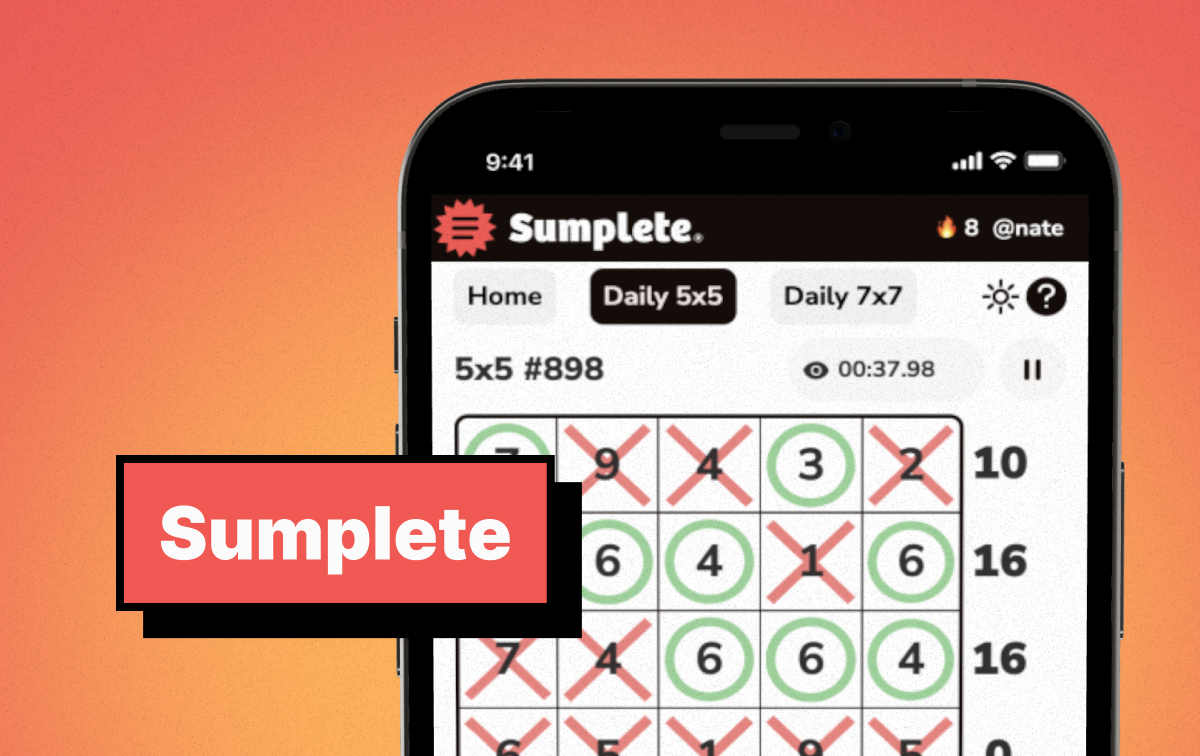
- Sumplete — Square grids are solved through arithmetic-based elimination. Players must ensure the sum of each line matches the corresponding row/column sum clues to win the game.
- Sudoku — Players must fill in numbers 1–9 in every row, column, and 3x3 box within a square grid without repeats.
- Mini Sudoku — A faster 6×6 variant of Sudoku with 2×3 blocks and numbers 1-6. Offers the same constraint logic benefits as classic Sudoku but in 5-10 minutes instead of 15-30, making it ideal for daily brain training.
- Kakuro — This game requires players to fill in cages with values that match the target sums above and to the left of each line. This game is similar to Sumplete, but the grid shape can vary.
- KenKen — Operation-based logic is needed in this game as players use addition, subtraction, division, and multiplication to solve arithmetic cages within a square grid.
Best for: Analytical thinkers and people who like to solve puzzles with mathematical precision.
For a full breakdown of the best free number games for adults, see our dedicated guide.
Visual and Spatial Logic Puzzles
These kinds of puzzles are solved through pattern recognition and spatial reasoning.
Notable examples:
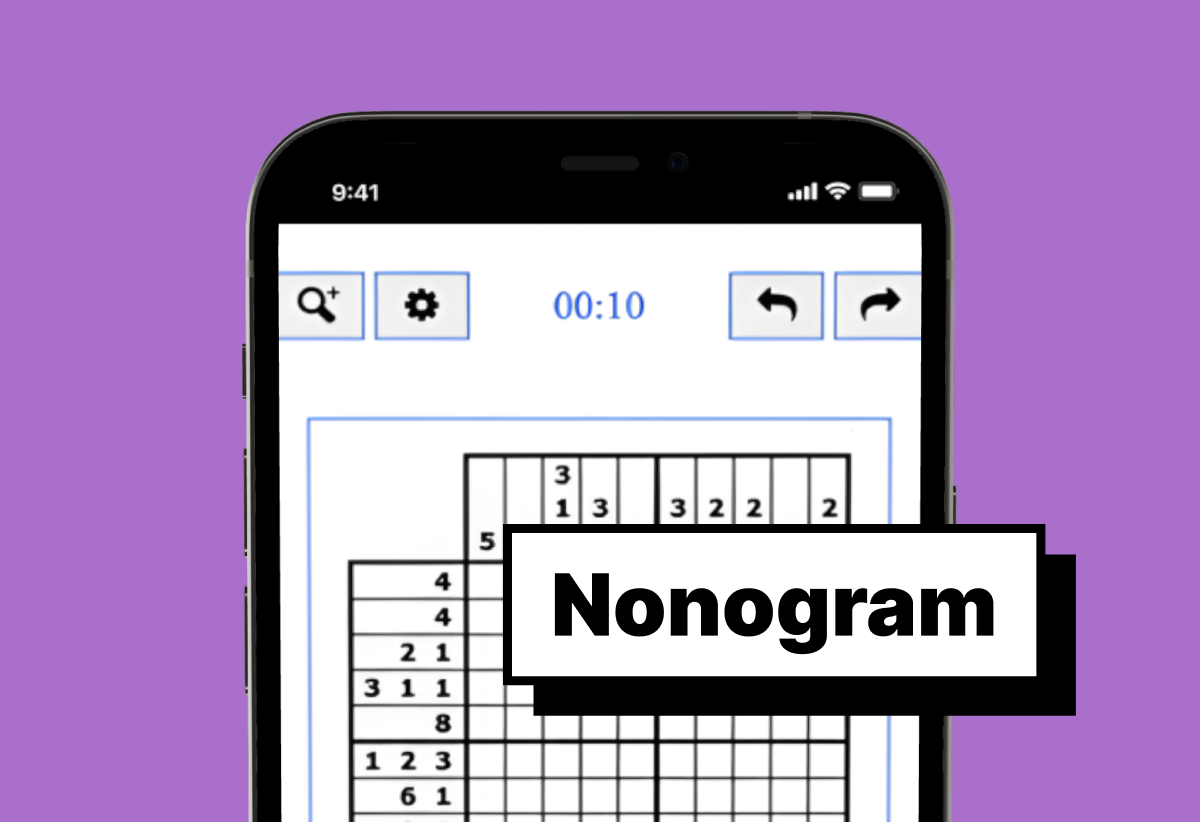
- Nonograms (AKA Picross or Griddlers) — Players reveal end-game images by adding shaded squares and empty cells to a grid, using line clues to guide their placements.
- Hitori — A game with simple rules, but challenging boards. Players remove numbers from a square grid to eliminate duplicates in rows/columns, all while ensuring no two shaded cells are adjacent to one another. Players must also link all non-shaded cells in a single group, which is made possible by horizontal or vertical connection paths.
- Slitherlink — Lines are drawn between dots to form a single loop without crossing paths or adding branches; border clues indicate the number of lines that must surround specific sections within the playing board. Players must use spatial logic to guide their loop to victory.
- Tents & Trees — Tents are placed onto a square grid based on the line clues at the top and left of the playing board. Trees must be paired with tents, either horizontally or vertically, on a 1:1 basis. Tents are not permitted to touch horizontally, vertically, OR diagonally.
- Queens Ultimate* — A colorful logic puzzle where your goal is to put queens on a grid without repeating them on the same row, column, and region. Queens game placements are also not allowed to touch diagonally, as well. Popularized by LinkedIn*, this version of the game offers a lot more content and modes to play.
Best for: Visual thinkers, artists who enjoy imagery, and design-minded adults.
Deduction and Grid-Based Puzzles
We’ve covered a lot of games with similar playing boards, but these classic logic puzzles are a little different. These games are defined by reading comprehension, critical thinking, and clues that are essential to determining each answer.
Notable examples:
- Einstein Puzzles: Logical word puzzles that combine reading comprehension, mathematical operations, and attention to detail. Players must take note of multiple clues to find the answer to the puzzle, which essentially functions as a riddle.
- Whodunit Deduction Puzzles (Murdoku): This game pairs components of Einstein puzzles with those of number-logic puzzles like Sudoku, challenging players to identify the culprit of a crime through written clues and logic-based gameplay.
- Mastermind-style codebreakers: Mastermind games can be played against another player or a computer. Codebreakers attempt to guess the codemaker’s secret code (a series of four colored pegs) using deductive reasoning faster than their opponent can during their turn as the codebreaker.
Best for: Fans of mysteries and constraint-based thinking.
Word Logic Puzzles
Daily word and logic games that marry vocabulary and deduction. Math enthusiasts beware — the book nerds will probably thrive playing the following titles.
Notable examples:
- Crosswordle: This blend of crosswords and Wordle sees players use logical reasoning and letter/word deduction. Fans of both classic games should find this newcomer very engaging as they solve for letter placement within the confines of a crossword puzzle. And if you're looking for something more traditional, why not try the free Midi Crossword instead?
- Word ladder puzzles: Players must form derivative words from a starting word by solely changing one letter at a time without rearranging the order of the letters. This title serves as a great test of vocabulary and sequential reasoning.
- Cryptograms: Linguistic intuition is required for players to solve cryptograms. Each puzzle begins with an encrypted word or phrase, meaning each letter has been exchanged for a different letter. Players must leverage deductive reasoning and pattern recognition to decrypt the original phrase.
- Logic Crosswords: Also known as logic puzzles or logic grids, logic crosswords require players to use written clues to solve a grid comprised of categories. Each category has the same number of options listed on the board. Players are tasked with identifying which pairs (intersections on the grid) are valid based on the aforementioned clues.
- Pair Down: This daily word puzzle turns language into a decluttering exercise through deductive reasoning. Players trim away letters to reveal hidden words, but there's a twist — the letters you eliminate spell a new word as well.
Best for: Readers, writers, and language-oriented solvers.
Hybrid Logic Puzzles
Can’t settle on a single reasoning system? Hybrid logic puzzles might be for you — these games combine multiple systems, often taking inspiration from multiple iconic titles in the process.
Notable examples:
- Hashi (Bridges): Hashi players connect islands on a rectangular grid to form a single, connected group by drawing bridges between them. Bridges must begin and end at distinct islands, travel in straight lines, and not cross any other bridges or islands. A maximum of two bridges can connect a pair of islands, and the number of bridges connected to each island must match the number on said island. Patterns, numbers, addition, and deduction. What else could a puzzle enthusiast ask from a game?
- Futoshiki: In this game, inequality constraints, basic math, and deduction are used to solve for the values of empty cells across a square grid. There are a few pre-filled numbers on the board, guaranteeing a single unique solution. Players must ensure each row and column contains numbers 1 to the highest playable digit, without repeats. However, players must also ensure their placement logic complies with the greater than and less than signs scattered across the grid.
- Killer Sudoku: This Sudoku-Kakuro hybrid requires players to fill rows, columns, and squares with the numbers 1-9 without repeats while simultaneously filling in cages with values that, when added, match the cage target number (repeats are also not permitted within cages). Strong deduction and mathematical skills are essential for this puzzle.
Best for: Adults who prefer games with layered difficulty.
What Are the Best Free Logic Puzzles to Play Online?
Several quality websites offer high-quality, free logic puzzles online today, including:
1. Sumplete daily puzzle
Sumplete offers fast arithmetic-logic puzzles with Daily 5×5 and 7×7 challenges that pit players against one another to see who can solve each board in the least amount of time. Learn how to play Sumplete now!
2. Queens Ultimate
Queen's Ultimate: daily logic placement puzzle offers a wide range of grid sizes and difficulty settings for all kinds of players looking for a fun logic puzzle that's appealing to the eyes and easy to understand.
3. Puzzle Baron
Puzzle Baron lets you generate new logic crossword puzzles across 6 different grid sizes and 3 different levels of difficulty.
4. Nonograms.org
You will never run out of Nonograms on Nonograms.org. Its massive database of over 60,000 visual logic puzzles is one of the most expansive libraries offered for free today. Though what is a Nonogram exactly?
Which Logic Puzzle Fits You Best?
You should pick your logic puzzle based on the cognitive skill(s) you want to train:
Want faster mental math?
To improve your mathematical quickness, you can try playing Sumplete, Kakuro, or KenKen.
Want visual logic?
If you need something a bit more visually engaging, the best free Nonograms games or Hitori will be your best bets.
Want pure deduction?
If you’re truly someone who thrives when it comes to leveraging deductive reasoning to your advantage, you will find logic-grid puzzles or logic-grid crosswords very enjoyable.
Want short, daily hits of logic?
For something cyclical and straightforward, try one of Sumplete’s Daily boards.
Want something with letters and words?
Then it's best you read our online crossword puzzles guide, as that's more in the territory of vocabulary than logic.
Are Logic Puzzles Good for Brain Health?
Yes, logic puzzles have been proven to be beneficial to long-term brain health. Multiple studies, including a recent report by Harvard Health, have linked logic-based problem-solving to improved cognitive function. Adults who play logic-based puzzles can make substantial improvements to their mental agility with a daily brain puzzle routine, including:
- Improved processing speed and working memory
- Enhanced pattern recognition
- Reduced risk of cognitive decline
Remember — consistency matters more than intensity. Solving 9x9 Master Sumplete boards is great, but your main goal should be to play each day in short bursts. If you're unsure of how to proceed, use our brain puzzle guide as a basis.
Aim to play for 5–10 minutes of logic puzzles per day to give your brain a daily training session. It will thank you in the long run!
FAQ
What are the best logic puzzles for beginners?
The best logic puzzles for beginners are Sudoku, Sumplete, and Nonograms. All three offer simple, straightforward gameplay, perfect for newcomers.
Are logic puzzles actually good for your brain?
Yes, logic puzzles are, in fact, good for your brain. They are especially beneficial when played on a regular basis, which is why daily games like Wordle remain extremely popular even after the COVID-19 pandemic. If you're into daily games but are tired of Wordle, see our list of Wordle alternatives.
What makes a puzzle “logical”?
A puzzle is categorized as “logical” if it can be solved through deduction without guessing. If a puzzle can be solved only through guessing, the game cannot truly be categorized as logical.
What are the hardest types of logic puzzles?
The hardest types of logic puzzles include Killer Sudoku, extremely expansive Nonograms, and advanced logic grid puzzles.
Related Guides
- Number Logic Puzzles Daily Guide
- What Is a Nonogram?
- Nonogram vs Sumplete
- Top Puzzle Games Like Sumplete
- How to Play Sumplete
*Queens Ultimate is not affiliated with LinkedIn or its games.
 Mini Crossword
 Midi Crossword
 Diffle
 Killer Sudoku
 Numberle